How to Pitch your Financial Projections
February 29, 2016

I've reviewed thousands, maybe tens of thousands of pitch decks, covering early, growth and late stage venture capital and private equity. There's a flow to presenting the argument of a business opportunity that can create a mind meld between an entrepreneur and an investor, where you're able to spend your time appropriately around the key insights, bets, and questions behind the product, business, and team. Good pitches aren't just pitches, but conversations.
Yet far too often, I've seen a great flow break down when it comes time to discuss the financials. After slides full of crisp, clear illumination of the problem, solution, market, team and plan, the financials are often left to a header like "Financial Summary" and a screen capture of a five year projection of revenues, costs, and net income, and perhaps the ever-present hockey stick of growth of revenues, users, subscribers. Flow, killed.
But why?
My plan is conservative.
No, it's probably not, and even if it is, presenting a set of three or five year financial projections and then confidently calling it conservative misses the point. Why do investors, as is the common rule of thumb, take a look at a set of projections and cut it in half? The heuristics "it takes twice as long to get done" or "it takes twice as much money" are easy, simple ways to adjust a model that are often proved true when plans hit the real world, but the reason behind the dance is more nuanced.
Convervative or not, the reason why an investor doesn't believe an entrepreneur's projections often isn't in the projections themselves but the way they are displayed and presented.
How can you have a good conversation about a business with a slide like any of these?
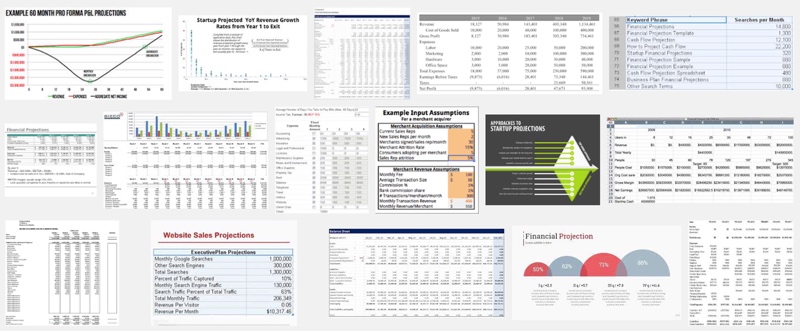
Don't make anyone figure out your key points. Tell them directly.
Neither a chart of projected growth nor a screen capture of a three to five year projected income statement works because it doesn't make the story clear. Most slides in a deck work to simplify the key insight and present data to construct the argument; but in these cases, all of the data is presented, usually without commentary, without making the key insights clear. It's left up to the reviewer - the investor - to make their insights, and usually, we simply don't. We focus on other areas of analysis because we can use our gut and our instincts around human and corporate behavior to ground our thoughts, but with this, we have no context, no bearing, no easy way to benchmark or understand the story.
Highlight operational fundamentals, not just financial projections.
The thing is, a three to five year projection isn't how an entrepreneur thinks. When you're getting started, you're not thinking about what revenue will be in three years, we're focused on two fundamentals:
- Does the business work on a per-customer basis at any point in the business?
- Can the business grow?
A chart obscures the instinctual analysis we do when we think about our businesses. It hides many conflicting trends happening in the business, and obscures the simple questions we ask ourselves. Does it solve a problem, will people pay for it, can we provide it for less than it costs us, and can we grow it.
That's the better way to talk about and present the financials for a business: show how it works, show how it can grow, and show it's big.
User economics
Per-user eonomics are key. This is whay SaaS businesses are obsessed with LTV (long-term value) and CAC (customer acquisition cost) and many other customer metrics, because they have to focus on how a business makes money on a per-customer basis. It's not as simple as LTV greater than CAC, though: time to breakeven matters, upsell and expansion opportunities matter, MRR (marginal recuring revenue) matters, and many other metrics matter because they tie back to fundamental user economics. Solid growth can obscure poor user economics, but only for so long.
For help in creating and communicating your unit economics, download the free Unit Economics Forecasting for Excel and Google Sheets →
Market size
There's a reason why we - entrepreneurs and investors - care about market size. Sizing a market is hard to reduce to a set of formulas in Excel, and while we can do all the data analysis possible to forecast one's market size, they are still data points, not the answer. Markets can change if you change what people do. And that's why presenting a market sizing isn't as simple as stating how many people bought something this past year, or what a research firm projects people will spend three years from now: they are data points to help make your argument, but you still have to tell the full story.
If you've proven that the user economics can work and that the market is large enough, then you're left with one more question:
- What will it cost to find out?
Prove that you understand your costs
Interestingly, cost budgets are much easier for us to discuss. An entrepreneur can (generally) control their costs, but will have far less control over adoption of their product, and thus their revenue projections will be far more variable than their cost projections. That's what a cost budget frames the conversation around: what will it cost to find out if the business can work?
And this is key: the cost budget is important because it shows that you've thought about what it takes to actually build the business. It shows a plan for how you will spend the money you raise from investors. It shows you are thinking about who you need to hire, what you need to focus on, how you plan to balance your priorities over a specific timeframe in order to achieve key milestones for your business.
Key milestones could include:
- X number of customers, or users
- Key product launches
- Key results from beta users
- Signals of "proof" that the business is worth investing further capital into
The level of detail for a cost budget depends on the level of the business: the more unknowns in the business, the less detail the cost budget needs to have. Focus on hiring (what roles, when, and how much), acquisition costs (if you will be spending on acquisition), and major expenses related to building the product and the business.
The key in creating a cost budget is to not get lost in the details and let the small items take your attention from the big issues. Don't worry about each individual line-item; focus on the big items, and be clear about how you will use the money you raise, what you'll be able to achieve with that money, and how that positions you for further success.
For help in creating a cost budget, download the free Runway Tool for Excel and Google Sheets →
Financial projections are meaningless. Or are they?
Often times we think that because financial projections are wrong - that they can't accurately predict the future - that analyzing projections is a waste of time. I'd argue that's the wrong question. The question isn't whether they are right, but why or why not they won't be: not the numbers themselves, but the rationale behind them. I've written about this extensively in the past, but the crux is that we can't simply say that the projections are meaningless and thus we shouldn't care about them, but to reframe how we think of them.
So, the recap:
- Don't depend on the screen capture of the income statement to tell the financial story of your business.
- Be careful in how you pitch the "hockey stick" growth curve. If it's actual results, then highlight it, but if it's purely a projection, it will be tough to support on its own.
- Simple slides that explain user economics and and market size can effectively communicate key financial insights.
- Crisply explain the costs to start and operate the business to achieve key milestones over a certain period of time that maps back to your funding ask.
How to Structure Your Financial Slides
Instead of a screen capture of your income statement, structure your financial slides to tell a story:
Slide 1: Unit Economics
Show how the business works on a per-customer basis:
- LTV/CAC Ratio: Lifetime value divided by customer acquisition cost (aim for 3x+)
- CAC Payback Period: How long to recover acquisition costs (aim for <12 months)
- Gross Margin: Profit margin after direct costs (aim for 70%+ for software)
- ARPU: Average revenue per user/customer
Visual: Simple table or chart showing these metrics, with clear labels and context (e.g., "3.5x LTV/CAC means we generate $3.50 in lifetime value for every $1 spent on acquisition").
Slide 2: Growth Model
Show how the business can grow:
- Acquisition: How you acquire customers (channels, conversion rates, costs)
- Retention: Customer retention/churn rates
- Expansion: Upsell/expansion opportunities and rates
Visual: Simple funnel or flow chart showing acquisition → activation → retention → expansion, with key metrics at each stage.
Slide 3: Market Opportunity
Show that the market is large enough:
- TAM/SAM/SOM: Total addressable, serviceable addressable, and serviceable obtainable market
- Market Dynamics: Why the market is growing or changing
- Your Position: How you'll capture market share
Visual: Market sizing with clear methodology, not just a big number. Show the logic behind the numbers.
Slide 4: Use of Funds
Show what you'll do with the money:
- Hiring Plan: Key roles and timing
- Key Milestones: What you'll achieve with the funding
- Timeline: When you'll hit milestones and need next funding
Visual: Timeline or Gantt chart showing milestones and funding needs over time.
Slide 5: Financial Summary (Optional)
If you include financial projections, make them simple and focused:
- Revenue Growth: Show revenue growth trajectory (not just a number)
- Key Metrics: Highlight 2-3 key financial metrics (revenue, burn, runway)
- Assumptions: Briefly note key assumptions (don't list everything)
Visual: Simple chart showing revenue growth and key milestones, not a full income statement.
Presenting Financials at Different Stages
How you present financials should evolve with your stage:
Pre-Seed / Seed Stage
Focus: Unit economics, market opportunity, use of funds
Detail Level: High-level, focused on fundamentals
Projections: 12-18 months, focused on milestones not revenue accuracy
Key Slides:
- Unit economics (if you have data)
- Market opportunity
- Use of funds and milestones
- Team and traction (if any)
Series A
Focus: Unit economics, growth model, path to profitability
Detail Level: More detailed, show you understand the business
Projections: 18-24 months, more detailed revenue and expense projections
Key Slides:
- Unit economics (with historical data)
- Growth model and acquisition channels
- Revenue projections (with assumptions)
- Use of funds and milestones
- Path to profitability or next milestone
Series B and Beyond
Focus: Financial performance, growth efficiency, strategic plan
Detail Level: Detailed financials, historical performance, forward projections
Projections: 24-36 months, detailed P&L, cash flow, key metrics
Key Slides:
- Financial performance (historical and projected)
- Unit economics and efficiency metrics
- Growth plan and key initiatives
- Use of funds and strategic milestones
- Path to profitability or exit
Beyond Pitch Decks: Financial Communication
Financial communication isn't just about pitch decks. Here's how to communicate financials in different contexts:
Investor Updates
Monthly/Quarterly Updates:
- Actuals vs. plan (with variance explanations)
- Key metrics (revenue, burn, runway, unit economics)
- What's changed and why
- What you need help with
Format: Simple email or one-page update, not a full deck. Focus on what's important and what's changed.
Board Meetings
Board Decks:
- Financial performance (actuals vs. plan)
- Key metrics and trends
- Strategic initiatives and progress
- Risks and opportunities
- What you need from the board
Format: More detailed than investor updates, but still focused. Don't overwhelm with data - tell a story.
Fundraising
Pitch Deck: As described above - focused on story, not data dump
Data Room: Detailed financial model, historical financials, detailed projections
Due Diligence: Be prepared to explain every assumption and number
Key: Pitch deck tells the story, data room provides the detail. Don't try to do both in the deck.
Handling Questions About Financials
When investors ask about your financials, here's how to respond:
"Are these projections conservative?"
Don't say: "Yes, they're conservative" (everyone says this)
Do say: "These projections are based on [specific assumptions]. Here's how we'll achieve them [specific plan]. If we're wrong, here's what would change [scenarios]."
"What if you're wrong?"
Don't say: "We won't be wrong" or "We'll figure it out"
Do say: "Here are the key risks [specific risks]. Here's how we'll mitigate them [specific plans]. Here's what we'd do if things don't go as planned [scenarios]."
"How did you come up with these numbers?"
Don't say: "We just estimated" or "Industry benchmarks"
Do say: "Here's our methodology [specific approach]. Here's the data we used [specific data]. Here are the assumptions [specific assumptions]."
"What's your path to profitability?"
Don't say: "We'll be profitable in year X" without explanation
Do say: "Here's our unit economics [show LTV/CAC, margins]. Here's our growth plan [show acquisition and retention]. Here's when we'll reach profitability [show math]."
Scenario Planning and Sensitivity Analysis
Instead of presenting one set of projections, consider showing scenarios:
Base Case
Your most likely scenario based on current assumptions and plans.
Upside Case
What happens if things go better than expected:
- Faster customer acquisition
- Higher retention
- Better unit economics
- Faster product development
Downside Case
What happens if things don't go as planned:
- Slower customer acquisition
- Higher churn
- Lower unit economics
- Delays in product development
How to Present: Show key metrics (revenue, burn, runway) under each scenario, and explain what would need to happen for each scenario.
Common Mistakes to Avoid
- Data Dump: Don't show every number - focus on what matters
- No Context: Don't show numbers without explaining what they mean
- Unrealistic Projections: Don't show projections you can't support
- Ignoring Actuals: If you have historical data, show it and explain variance
- No Assumptions: Don't show projections without explaining assumptions
- Too Much Detail: Don't overwhelm with detail - focus on key insights
- No Story: Don't just show numbers - tell a story about the business
The Bottom Line
Financial projections are a communication tool, not just a spreadsheet. Use them to:
- Tell the story of your business
- Show you understand how the business works
- Demonstrate you've thought through the plan
- Create a conversation, not a data dump
The best financial presentations don't just show numbers - they tell a story about a business that works, can grow, and is worth investing in.
For help building financial models that tell your story, see the Standard Financial Model. For help with unit economics, see the Unit Economics Tool and the Unit Economics doc. For more on the "vibes vs Excel" approach, see Vibes vs Excel.