Run your fund on software you own.
Portfolio monitoring, deal flow and diligence, limited partner reporting, and fund accounting, all in one platform. Open source, use the components you need, and customize for your design and needs. Self-host and your data and AI use stays with you.
Start here
Start with Portfolio Reporting. Take the updates already sitting in your inbox to a report an LP can read.
Forward the updates you already get
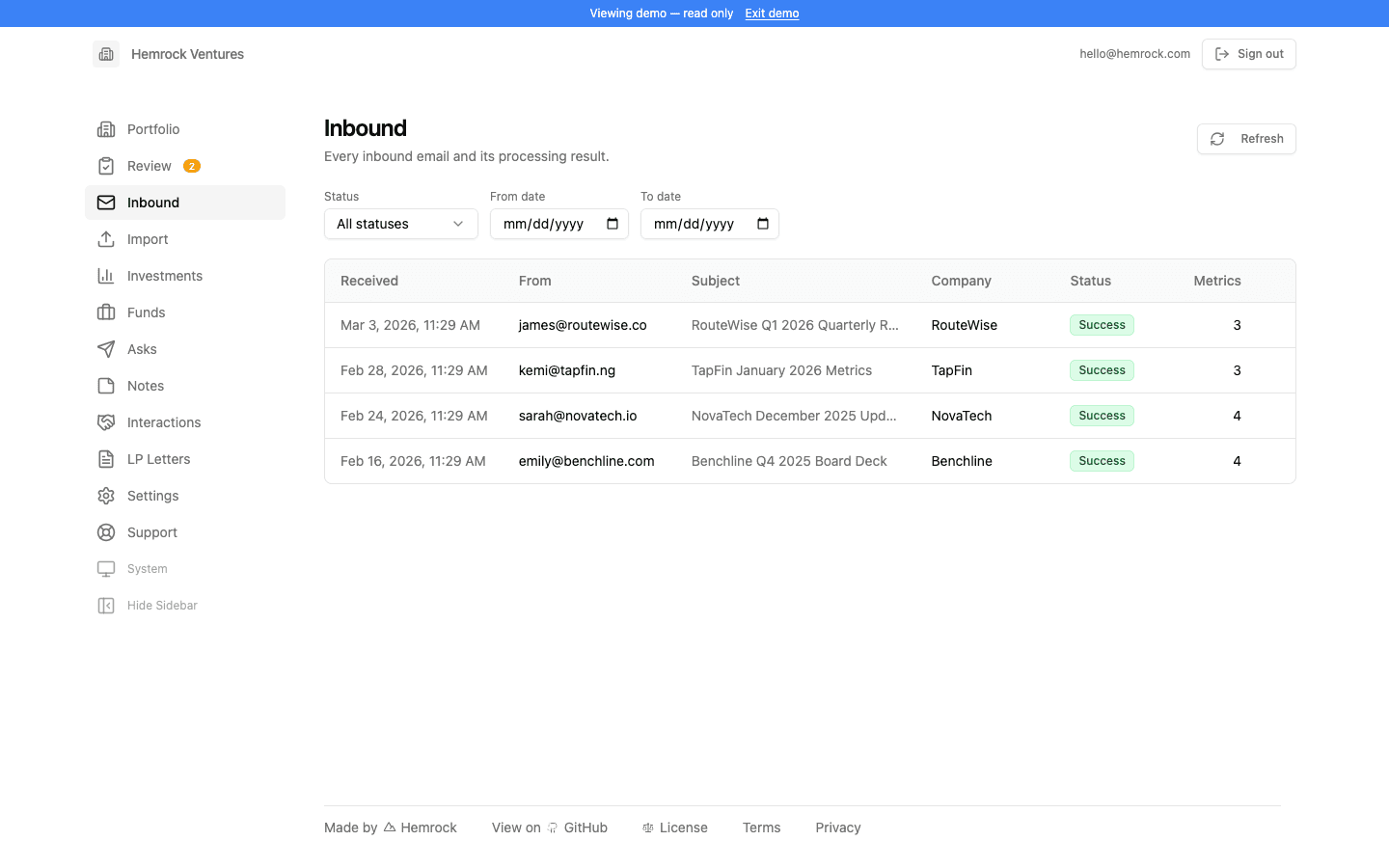
Give founders an inbound address and send investor updates to it in any format, PDF, Excel, PowerPoint, or plain text. AI identifies the company, extracts the metrics, and flags anything it's unsure about for you to confirm.
Import the rest of your portfolio
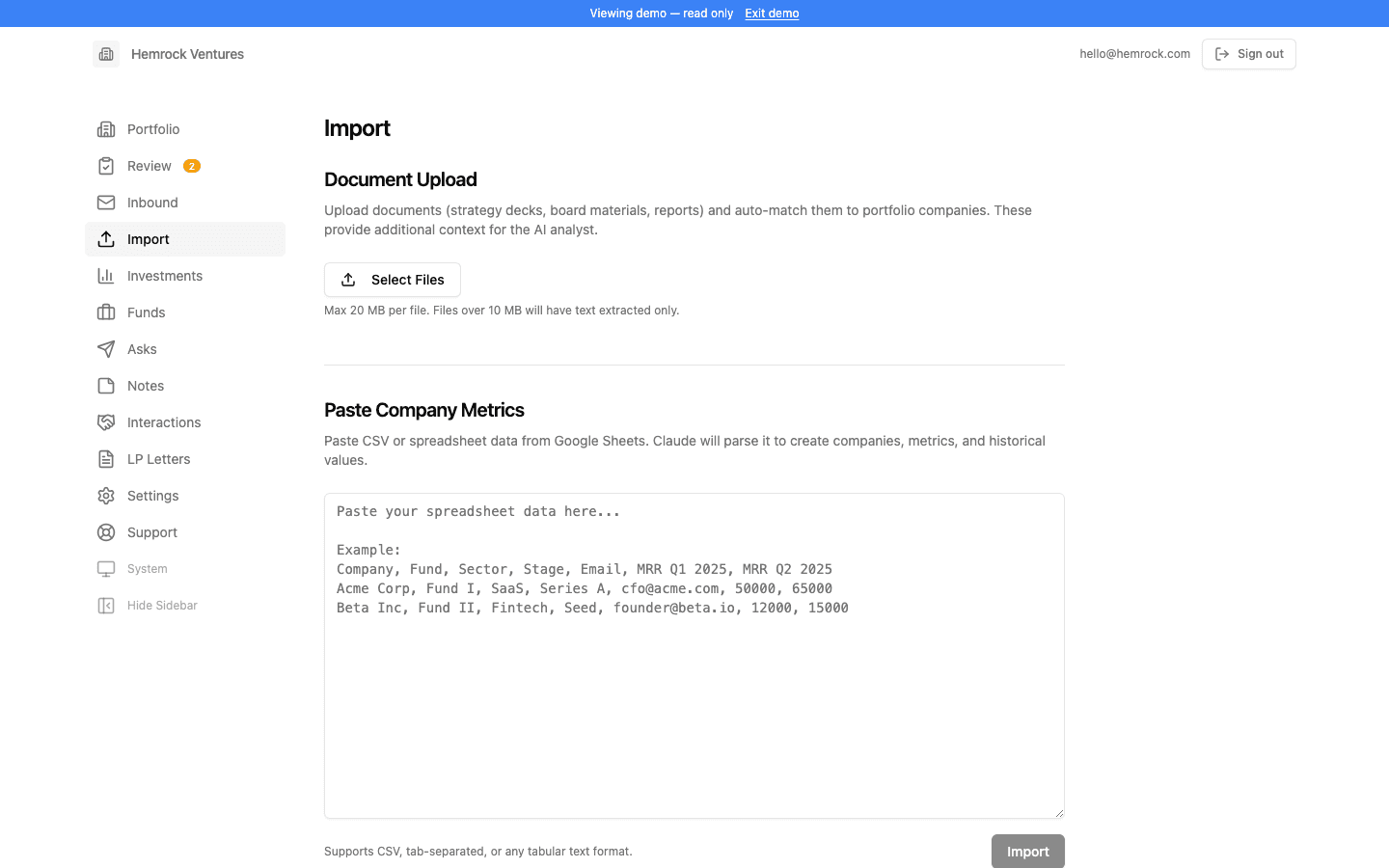
Paste text, upload files, or bulk-import a spreadsheet. The same pipeline handles metrics, investments, and cash flows, so a quarter of history lands in minutes instead of an afternoon of copy-paste.
Watch the dashboards build themselves
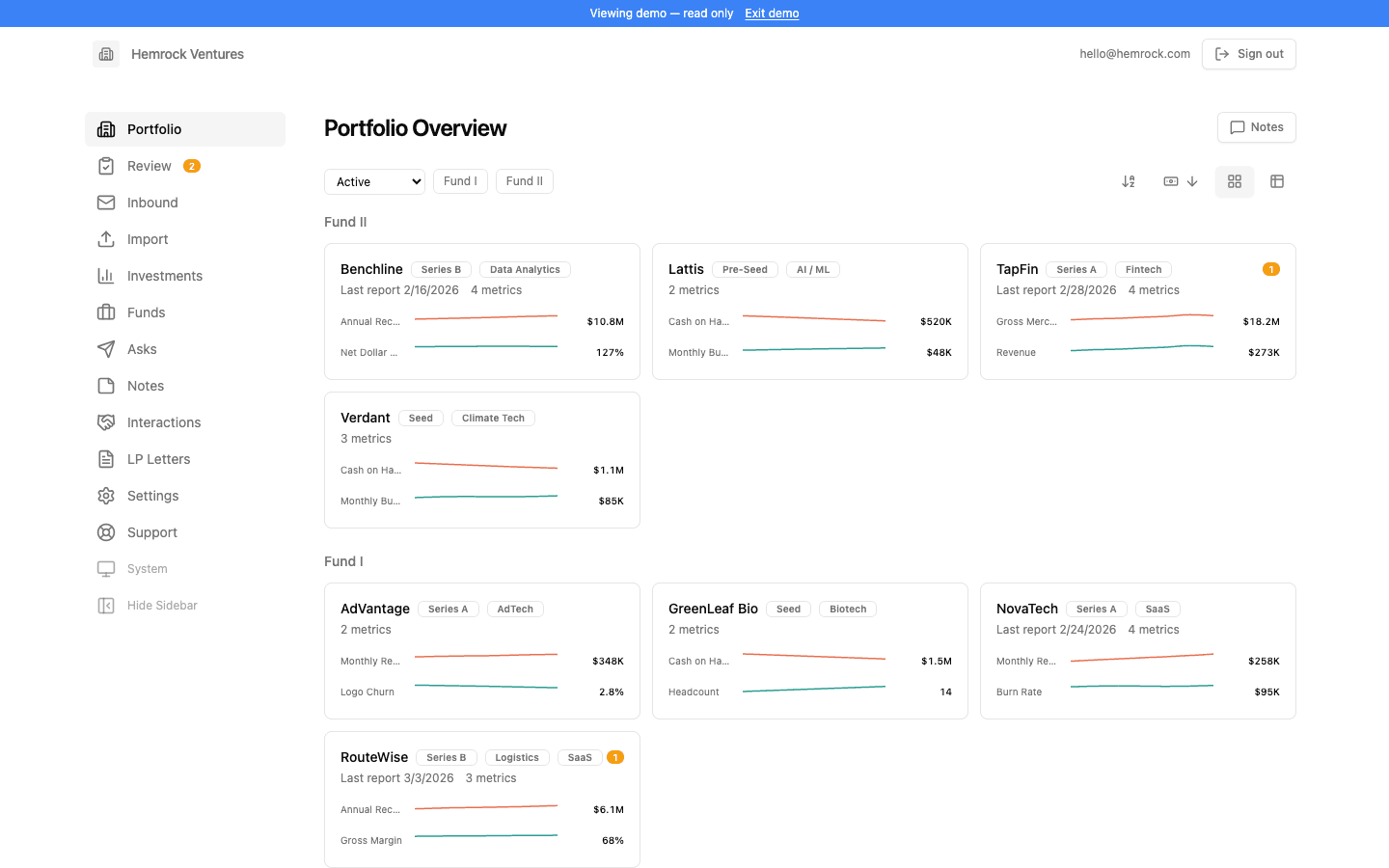
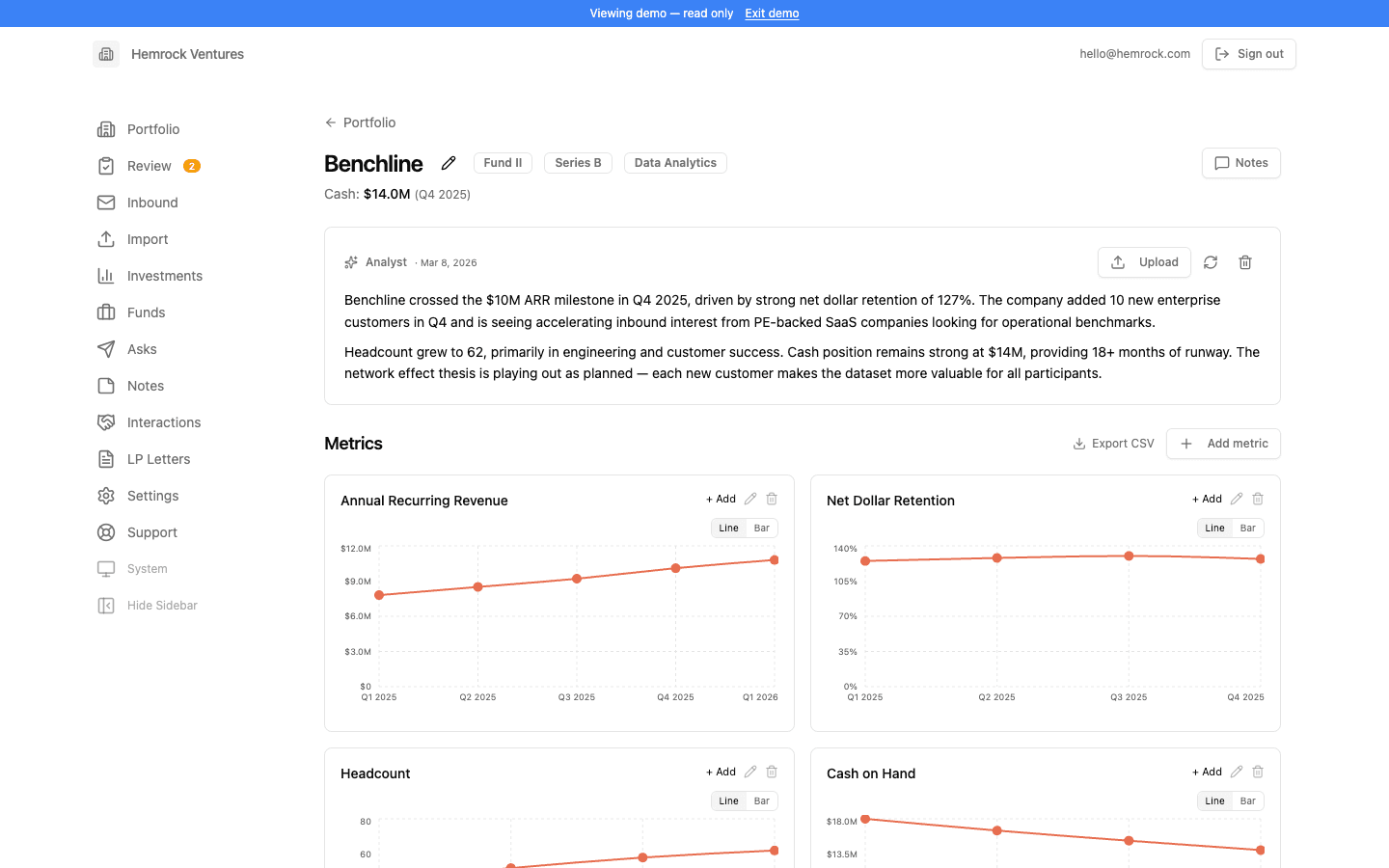
MRR, burn, headcount, and your custom KPIs chart over time from the updates as they arrive. One source of truth for company health, with the numbers your admin never touches sitting right next to fund performance.
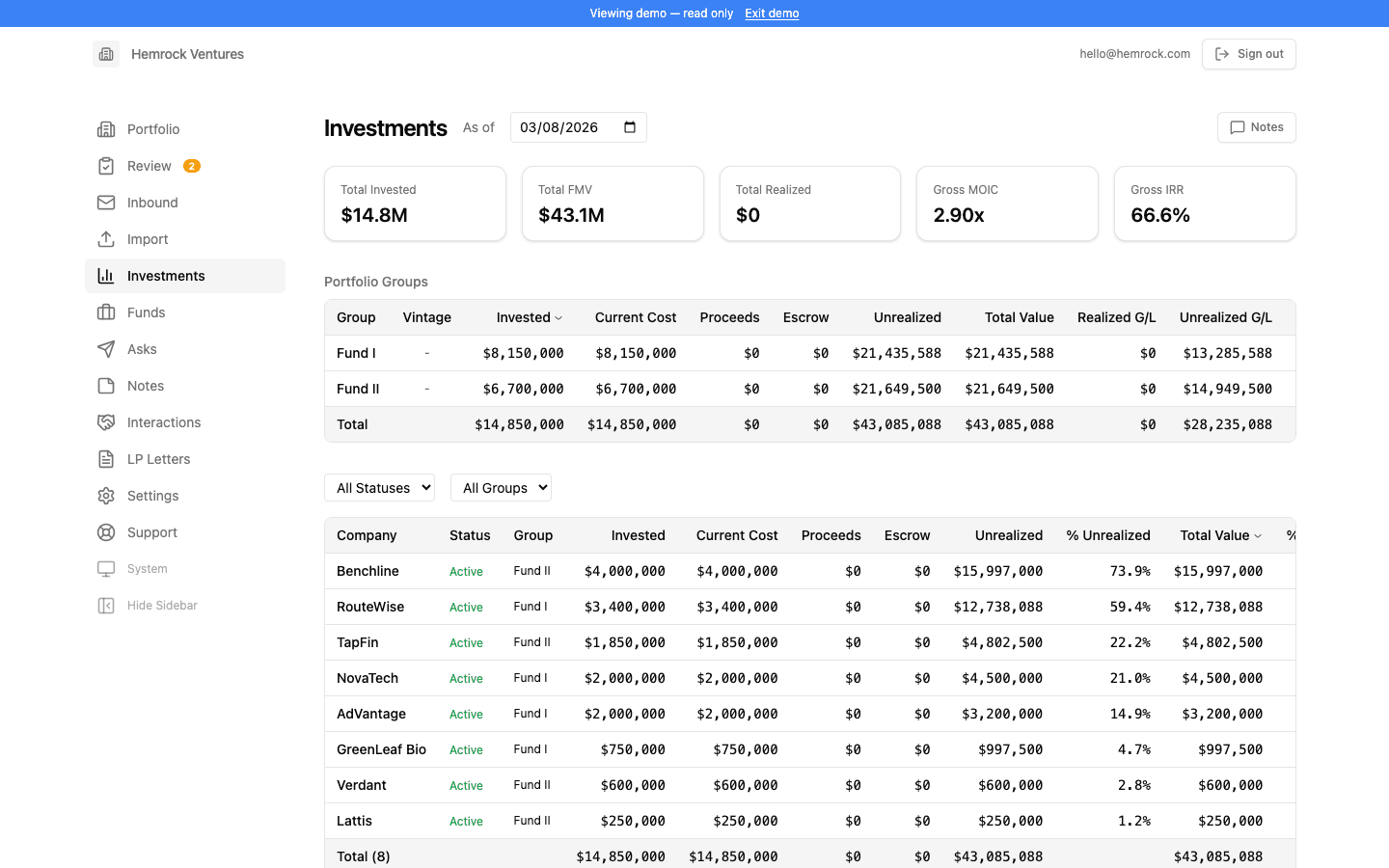
Report to your LPs from live data
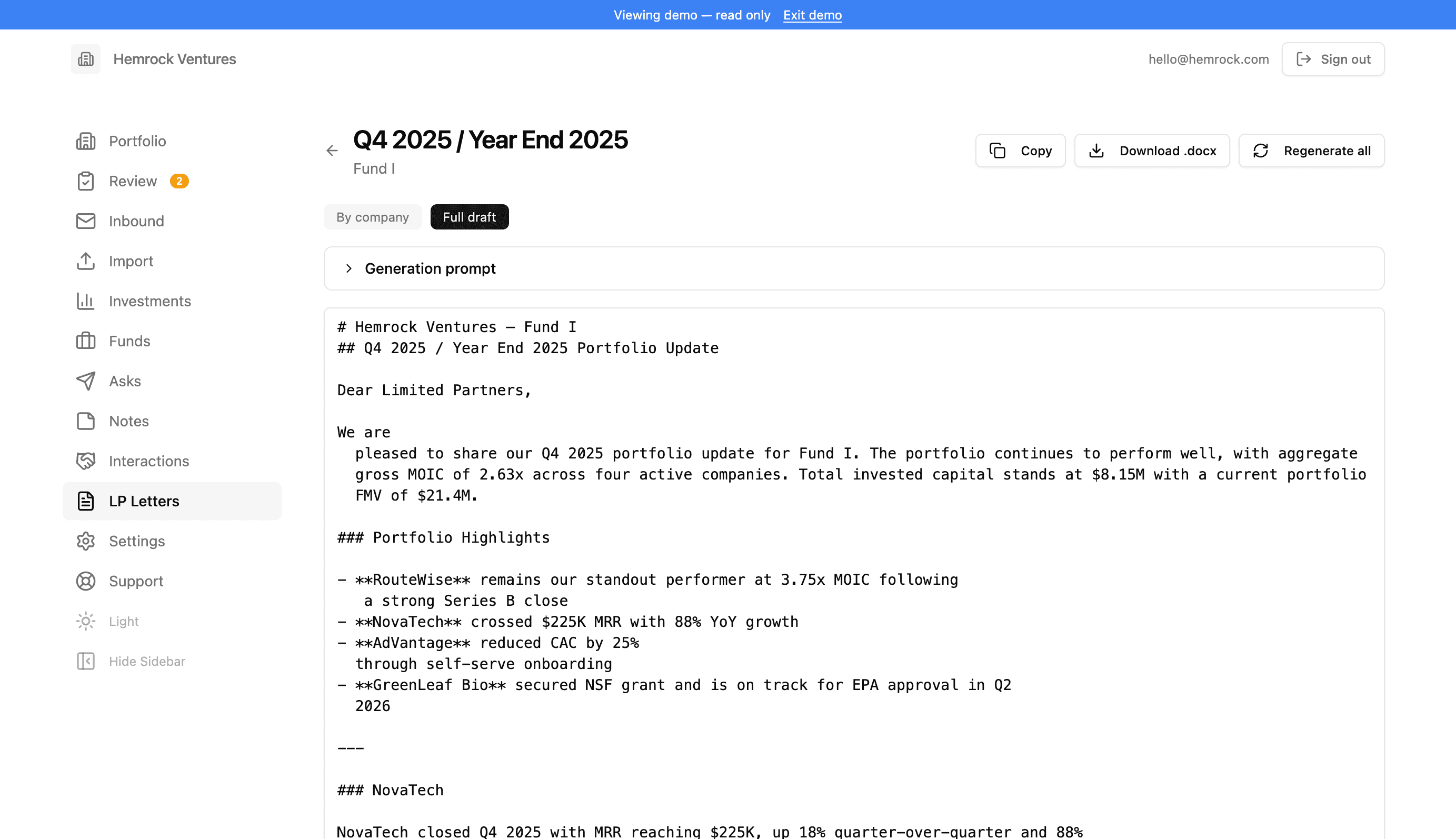
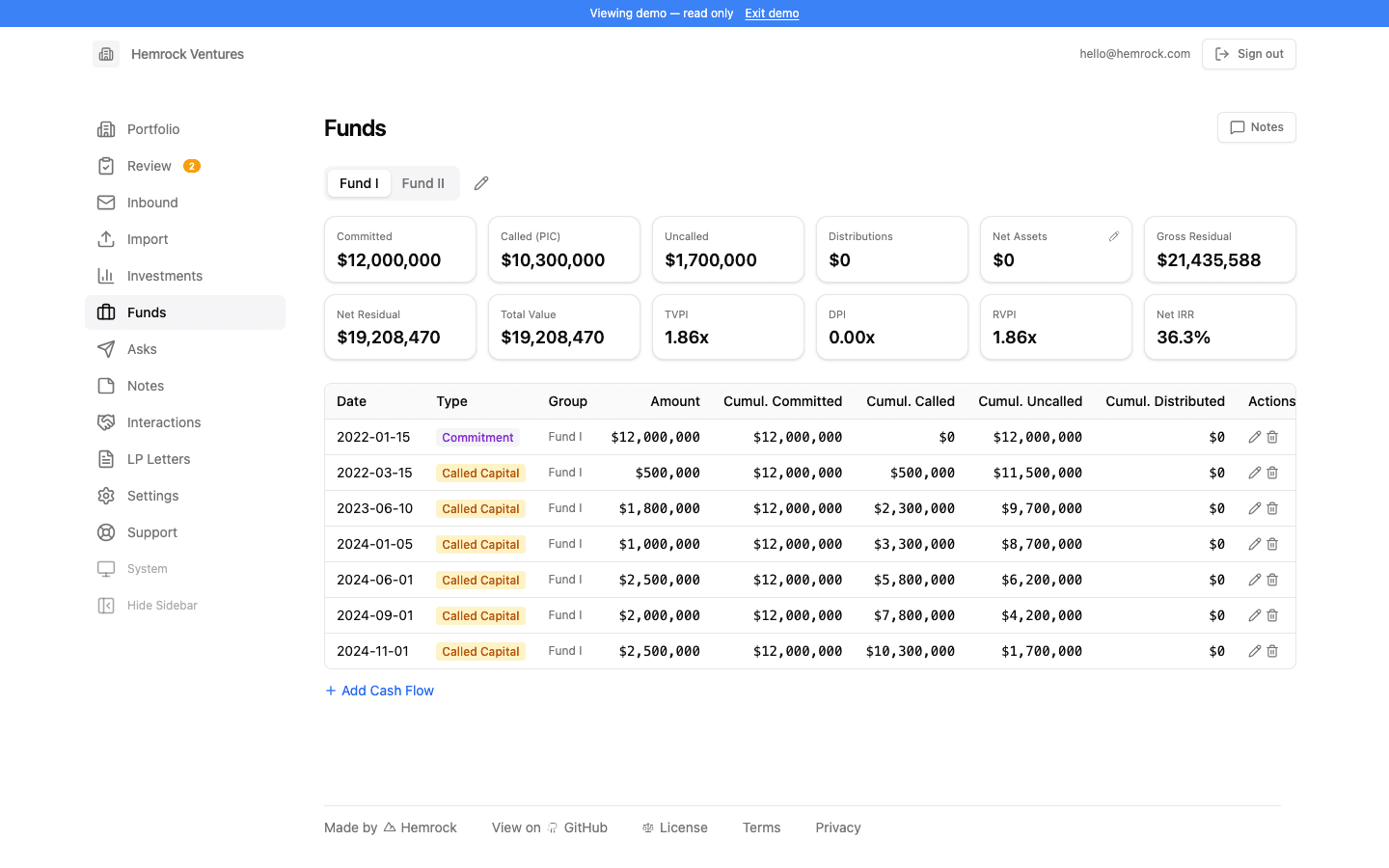
Draft quarterly letters, print investor report cards, or freeze a snapshot for the archive. TVPI, DPI, and Net IRR compute from the investments you've recorded, so an LP report is a click, not a rebuild.
The four products
One platform, four products. Use what you need right now, add the additional products when you are ready.
Portfolio Reporting
On by defaultThe operating data of the companies you're invested in, which is the layer your fund administrator never touches.
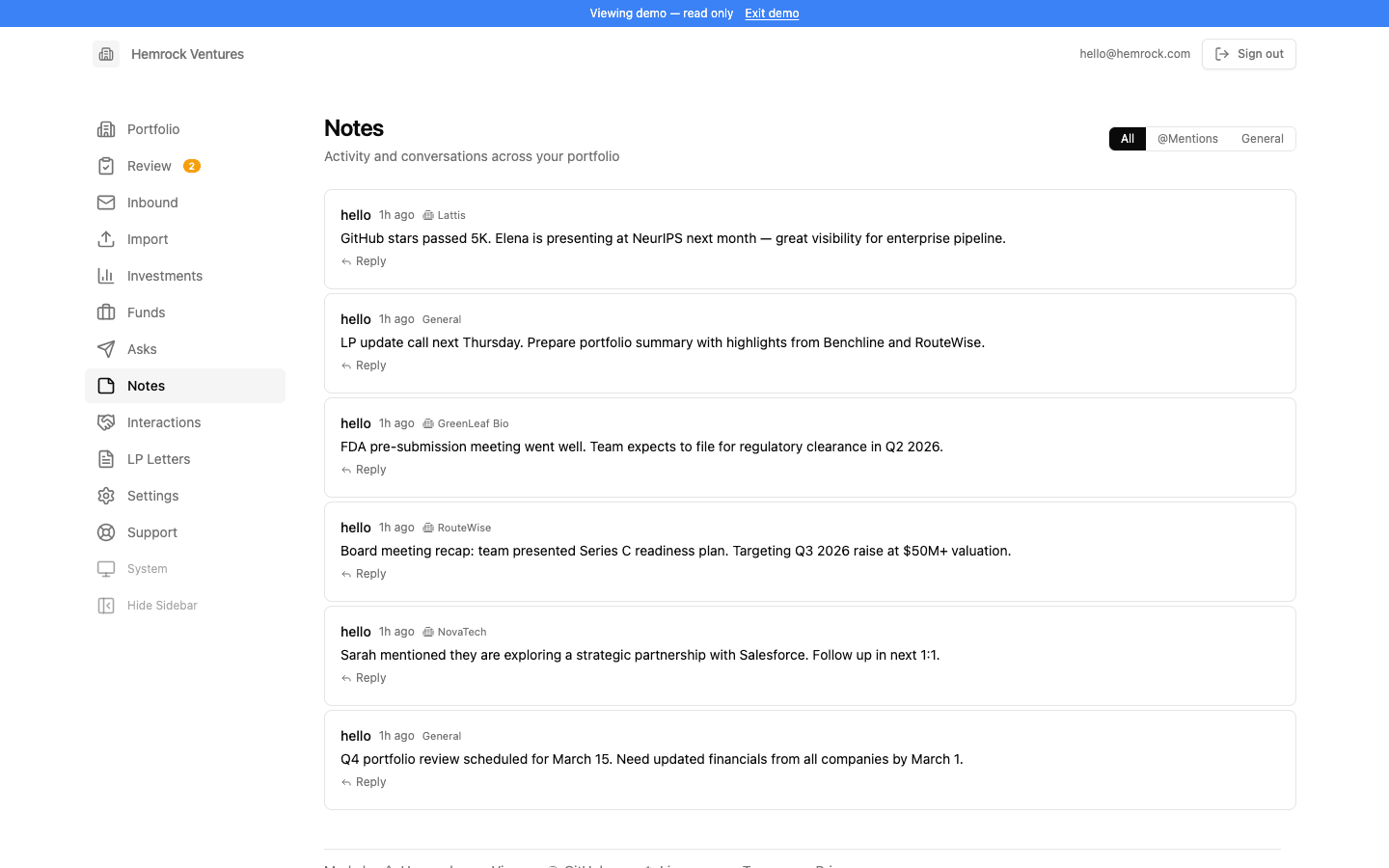
Founders send updates in whatever format they already use, and AI pulls the metrics out. Anything it isn't sure about waits in a review queue for you. MRR, burn, headcount, and your own KPIs chart themselves as the updates arrive, and the intros and strategy notes sit next to the numbers instead of in a separate CRM.
Portfolio Reporting docsInvestment Workflow
Off by defaultEverything between a cold pitch landing in your inbox and a memo your partners can decide on.
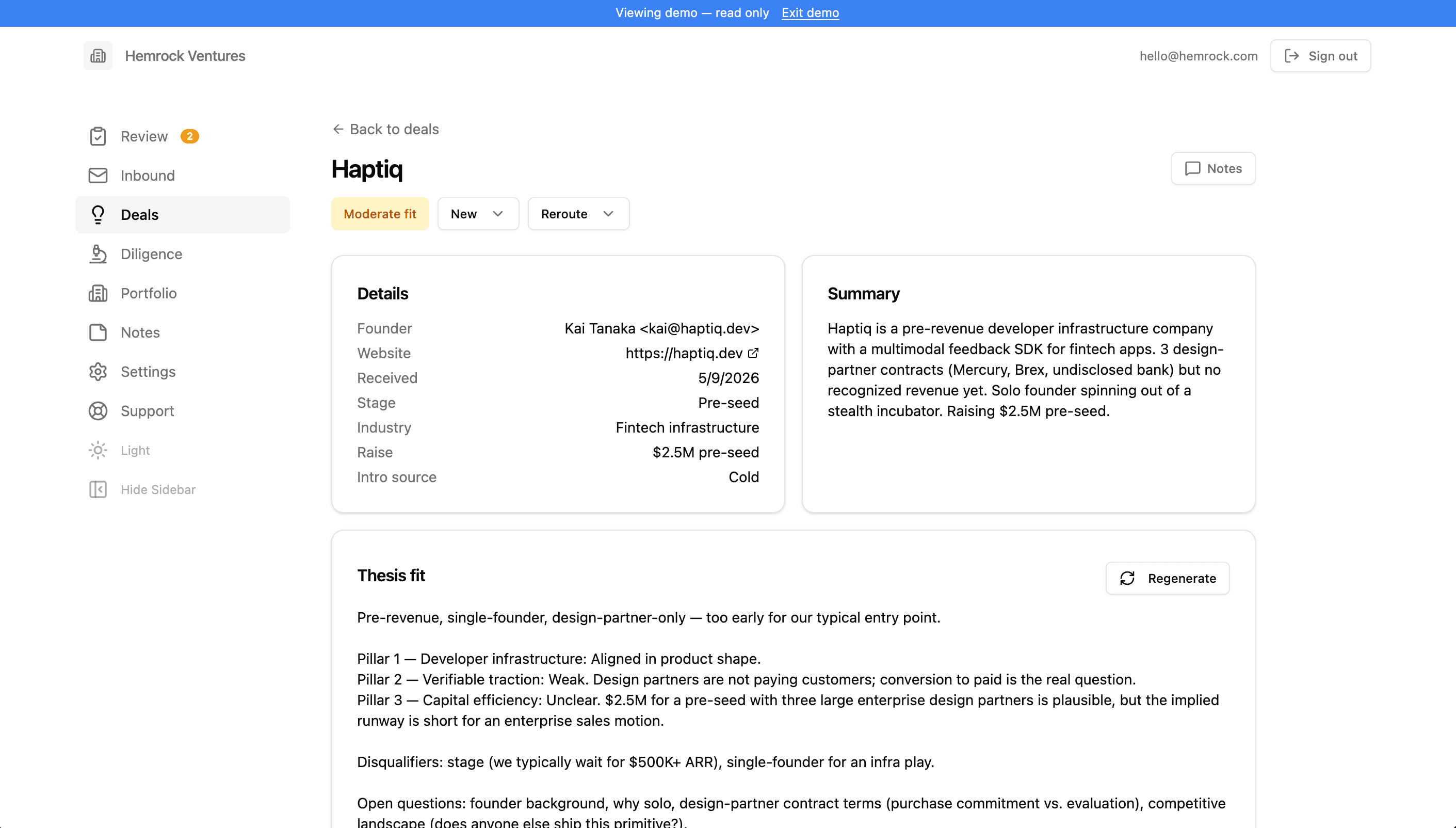
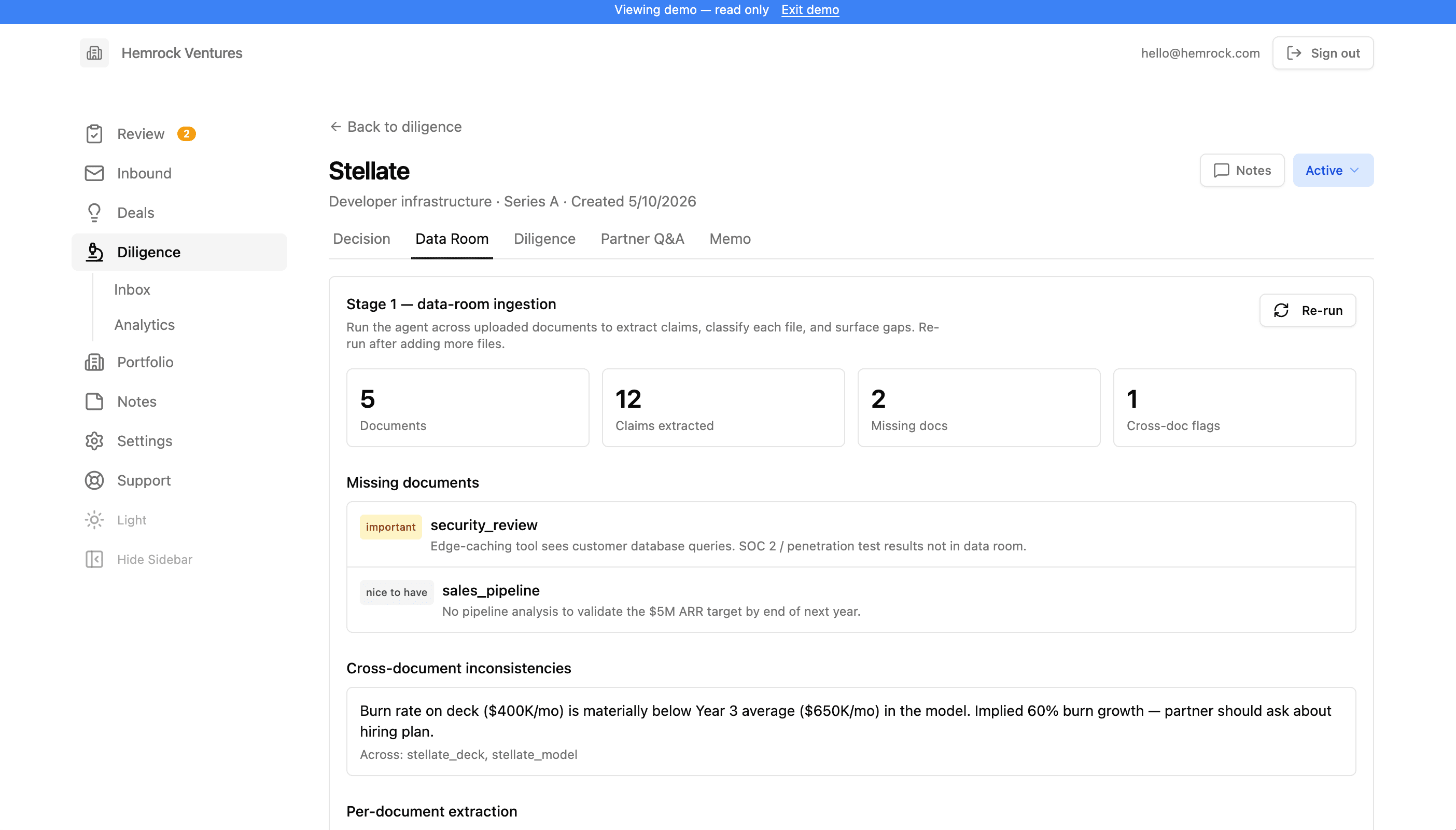
Inbound pitches get classified and scored against your thesis before they reach anyone, with an optional public form if you'd rather founders came to you directly. When a deal is worth real time, an agent reads the data room, runs outside research, puts the open questions to your partners, and drafts a structured memo with a citation on every paragraph, rendered to Word or Google Docs.
Investment Workflow docsLP Reporting
Off by defaultWhat your LPs see, and the capital record behind it.
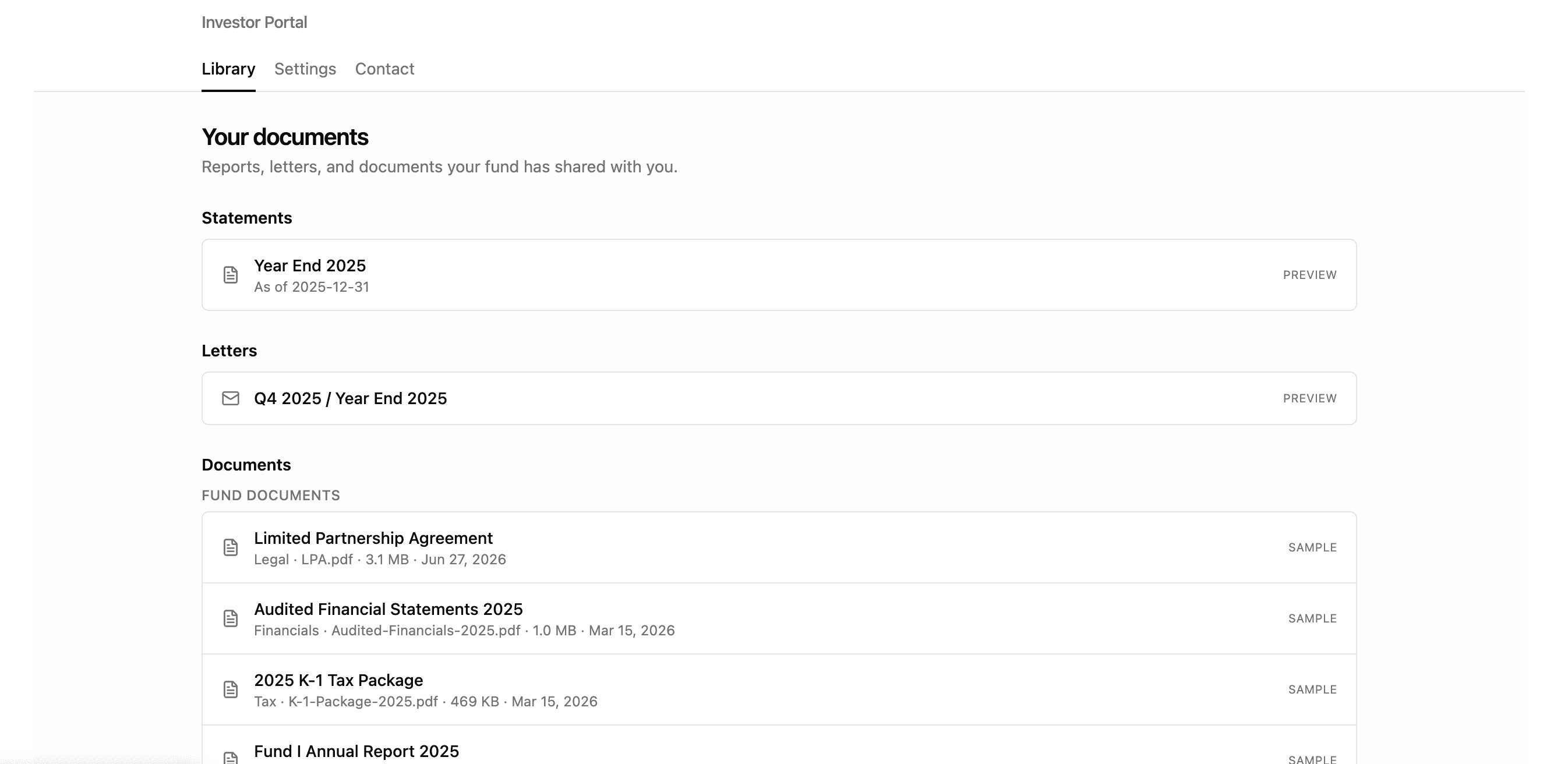
Paste a statement and AI maps the columns into a dated position, so a record builds over time and you can pull a capital account as of any date you like. Every LP rolls up across vehicles to the investor. They read the result in a private, fund-branded portal, where an AI analyst answers questions using only that LP's own materials.
LP Reporting docsFund Operations
Off by defaultThe books those LP numbers come from, when you want them coming from real books.
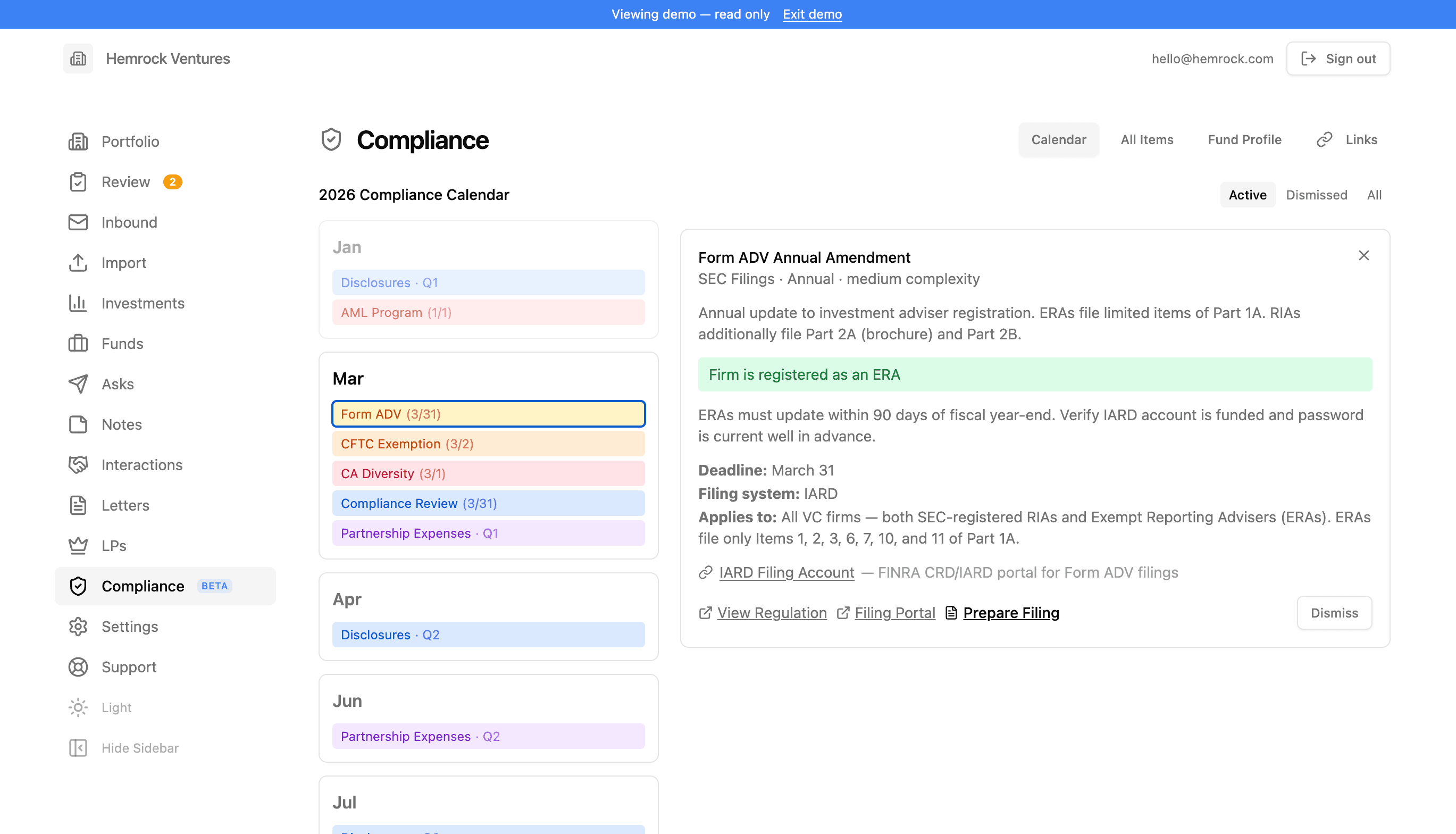
A double-entry ledger per vehicle: fund, SPV, direct deal, or GP entity. Import a bank feed, book calls and distributions, and close a period to allocate income into each partner's capital account, accruing note interest and carry as you go. The compliance calendar tracks the filings your structure actually triggers, so a deadline lands on a calendar instead of arriving as a surprise.
Fund Operations docsWho it's for
The same four products, in the combinations funds actually run. Start where you are.
SPVs
Run a single-deal vehicle like a fund: track the one company, its LP capital, and K-1s.
Portfolio Reporting · LP Reporting
Solo GPs and emerging managers
The back office you don't have. Report to LPs from live data, with real books when you want them.
Portfolio Reporting · LP Reporting · Fund Operations
Angels and syndicates
A wide portfolio of small checks, tracked from the founder updates you already forward.
Portfolio Reporting · Investment Workflow
Micro and seed funds
The full stack, screening through LP reporting and real books, on infrastructure you own.
Investment Workflow · Portfolio Reporting · LP Reporting · Fund Operations
Model what this doesn't
This tracks and reports on live data, and it stops there on purpose. When you need to model a cap table, an exit, or fund returns forward, that's what the Hemrock models are for. Same builder, and built to edit with AI.
Cap Table and Exit Waterfall
Per-company ownership and dilution across rounds, and what each holder takes home at any exit.
Fund Economics Tool
Management fees, carry, and net-to-LP returns, modeled before you report them.
Venture Capital Model
A full fund forecast, deployment pace through exits and returns.
Venture Valuation Tool
Value a company before you write the check.
An AI analyst, on your AI
Every part of the platform has an AI analyst behind it, and it runs on your AI, not mine. Bring your own key for Anthropic, OpenAI, or OpenRouter and switch providers whenever you want. Your fund data goes to your AI and nowhere else.
Ask it anything about a single company or the whole portfolio, then put it to work. It drafts LP update letters from your metrics and notes, categorizes bank transactions into journal entries for the ledger, proposes valuation marks, and answers your LPs' questions in the portal from that LP's own documents.
It works inside your access controls, never around them. The analyst only sees and acts on what the person using it is allowed to see. An LP's portal analyst answers from that LP's materials alone, advisors and accountants see only the accounts they're authorized on, and anything the AI writes to your books is a draft you approve before it posts.
Connect it to your stack
Your reporting data doesn't sit in a silo. Pull it into the tools your fund already runs, and let your AI reach it directly.
API
NewA fund API key drives the full tool surface from your own scripts and headless clients: companies, metrics, investments, LP positions, fund performance, and the ledger, scoped to what the key can reach.
MCP server
NewThe same surface over MCP, so Claude and other AI clients query your portfolio directly. Bring your data to your own AI instead of handing it to someone else's.
Webhooks
Coming soonSubscribe to events and push them into your own systems the moment they happen.
Affinity
PrebuiltA prebuilt integration that pulls deal and relationship data from Affinity into your portfolio and diligence views. One-way for now, Affinity into Hemrock.
Why this exists
Most portfolio reporting platforms lock your data in their database, run it through their AI, and charge per seat so half your team can't log in. Fund managers shouldn't have to choose between good tooling and owning their data.
This is the whole reporting platform, deployed on your own infrastructure: your database, your AI keys, your domain. No per-seat fees, no black-box AI training on your portfolio, no vendor lock-in. It's a real double-entry ledger when you want one, not a read-only dashboard bolted on top of someone else's numbers, and it exposes an MCP endpoint so the AI of your choice can query the portfolio directly. Ask it anything, about benchmarks, trends, or a single company.
I built it out of my own fund reporting work and made it something any manager can self-host. It keeps growing because I keep running into the next thing a fund needs.
How this is different
Own your data
Self-hosted on your infrastructure, your database, your domain. Nothing lives in someone else's multi-tenant cloud.
Bring your own AI
Your keys and your choice of Anthropic, OpenAI, Gemini, or a local model, with an MCP endpoint so your AI queries the portfolio directly.
Real books, not just a dashboard
A double-entry ledger per vehicle with period close and financial statements, so LP numbers come from books rather than a spreadsheet on top.
No per-seat fees
Your whole team and every LP logs in. Pricing doesn't punish you for adding people.
Make it yours
There are two ways to shape it around your fund. From settings, adjust colors, labels, and styling with no code, so it looks like your firm out of the box.
And because the whole thing is open source, you can go further than any settings panel. Install it, open the source, and change any part of the app itself, the look, the workflows, the functionality, whatever your fund needs that the defaults don't cover. Most platforms let you upload a logo. Here you own the code and edit it like you'd edit one of my financial models, with your AI doing most of the work.
Pricing
The software is free and open source under the Apache License 2.0. Run it yourself, or have me set it up and run it for you.
Self-hosted
Free
Run it on your own accounts
- Free and open source (Apache 2.0)
- All your funds, SPVs, and team, no per-seat fees
- Your infrastructure, your domain
- Roughly $0 to $75 a month in running costs
Setup and support
From $2,500
One-time, I deploy it for you
- Deployed on your infrastructure and accounts
- Setup, onboarding, and data migration included
- Ongoing support available
Hosted
From $250/mo
I host and maintain it, cancel anytime
- No infrastructure for you to run
- Onboarding your data and process included
- Ongoing support included
Common questions
Do I have to use all four products?
No, and most people shouldn't. Portfolio Reporting works on its own, and Investment Workflow, LP Reporting, and Fund Operations are independent switches, each off until you turn it on. Track LP capital from pasted statements with no accounting behind it, keep full books only for the vehicles you run yourself, or land anywhere in between.
Doesn't my fund administrator already give me portfolio reports?
A fund admin keeps the books of the fund. The core of this is the layer underneath that, the operating data of the companies you're invested in, which is the part most admins never touch. If you do want the accounting too, the ledger runs alongside your admin, or in place of one for the vehicles you handle yourself.
Is self-hosting a lot to maintain?
Less than it sounds. It's a standard web app you deploy once, and the quick start walks through it in an hour or two. If you'd rather not touch infrastructure, I can deploy it on your accounts, or you can go on the hosted subscription.
Is my portfolio data private?
Yes. You deploy on your own infrastructure with your own database and your own AI keys. Nothing is shared with other funds or used to train anyone's model. You own and control everything.
Which AI models does it use?
You bring your own key and pick the provider: Anthropic, OpenAI, Google Gemini, or OpenRouter, or a local model through Ollama. Switch whenever you want. AI powers the metric extraction, summaries, diligence, and letter drafting.
Can I modify the code?
Yes. It's open source under the Apache License 2.0. Use it, change it, and deploy it freely, for your own fund or commercially. I'm around to help with modifications if you want them.